
Authorization check: What should the irrigation proposal document for San Antonio?
Frame the San Antonio irrigation proposal around the specific property, its requested outcome, available documentation, and practical restrictions. Have the respondent list investigation, selected tasks, omissions, cost basis, and consent sequence.
Irrigation in San Antonio is a planning job before it is a digging job: the state requires a TCEQ licensed irrigator, the city requires a permit, and SAWS reviews the plan. This page walks you through scoping the system, hiring the right professional and getting through each approval. Questions about the yard around it? Call (210) 864-8662 or use our free quote form.
We are a landscaping company, not your irrigator. We don’t sell or perform irrigation installation, and we don’t quote system prices here. What we can do is help you decide what the yard needs, so the quotes you collect from licensed irrigators are comparable and the work lands on the right side of the rules.
What stage are San Antonio watering rules in right now?
On October 13, 2026, the SAWS homepage banner read “Stage 3 Rules in Effect,” and SAWS announced on September 21, 2026 that customers returned to Stage 3. Under Stage 3, landscape watering with an irrigation system is allowed once a week on your designated day, 5 to 10 a.m. and 9 p.m. to midnight.
Stage 3 begins when the 10-day rolling average of the Edwards Aquifer level drops to 640 feet above mean sea level at the monitored well. Your day comes from the last digit of your street address: 0 or 1 is Monday, 2 or 3 Tuesday, 4 or 5 Wednesday, 6 or 7 Thursday, 8 or 9 Friday. Drip irrigation and tree bubbler zones may run Monday and Friday during the same hours, and a hand-held hose is fine any day.
Two money details matter if you are planning a system. SAWS says a Stage 3 surcharge of $10.37 per thousand gallons applies to single-family water use above 20,000 gallons a month, and it affected under 2 percent of residential customers in the September notice. Water waste is handled by a charge on your bill, with a first charge of $137 for a single-family site that can be waived by taking a one-hour online course.
Stages change with the aquifer, so confirm on the SAWS drought restrictions page before you set a controller. We keep a plain-English version of the rules on our watering restrictions page and a Stage 3 summary on our Stage 3 page.
Does a San Antonio sprinkler system have to be done by a TCEQ licensed irrigator?
Yes. Texas licenses landscape irrigators through the TCEQ, and the state’s rules require irrigation work to be done under that licence. City code and the SAWS Utility Service Regulations say a licensed individual must be present and supervise the installation of a new system, and that a permit is pulled.
The TCEQ’s landscape irrigation page also notes that complaints against an unlicensed irrigator can now be filed in municipal and justice of the peace courts, and officers can issue a ticket under Texas Occupational Code Sec. 1903.256. Put simply, hiring an unlicensed person for sprinkler work is a risk that lands on you, not only on them.
Here is what the licence means in practice for you as the owner:
- The irrigator seals the irrigation plan. TCEQ says each licensed irrigator obtains a seal and may not perform landscape irrigation services without physical possession of the seal and the license.
- The licence number should appear on the paperwork you receive. SAWS’s garden article for homeowners says the work vehicle will always display the license number.
- The licensed person who supervises the work must show the licence to anyone who asks to see it.
We hold no irrigator licence and we are not that person on your job. The licensed irrigator you hire is.
How do I check that an irrigator’s licence is real?
Use the TCEQ’s public Licensing and Registration search, which is linked from the TCEQ Landscape Irrigation page. It lets you look up licensed or registered landscape irrigators and companies by name or number, and the TCEQ page also points to a way to find licensed individuals.
Run the check yourself before you sign anything. Take the name and licence number from the bid, search it, and confirm that the person on the paper is the person in the database. If the bid shows only a company name and no individual licence number, ask for the number in writing.
A few more checks that cost nothing:
- Ask which licensed individual will supervise your job, by name.
- Ask for the licence number on the written estimate, then verify it on the TCEQ page.
- If something goes wrong later, TCEQ has a page explaining how to file a complaint about a landscape irrigator.
Our own checklist for picking any contractor is on how to choose a landscaper in San Antonio. It applies to irrigators too.
What does our irrigation planning process look like, step by step?
A new irrigation system in SAWS territory runs through six stages: scope the yard, collect quotes from licensed irrigators, get a sealed plan reviewed by SAWS, pull the city permit, build and test, then pass the SAWS inspection. Most of the waiting is paperwork, and a good irrigator handles the filings.
- Scope the yard (a few days). Decide what the system has to cover: turf, beds, trees, a vegetable garden. Walk the lot and note where grass will be, where you want drip, and where the soil is thin. You decide the planting plan first, because the irrigation design follows it.
- Collect quotes from licensed irrigators (one to two weeks). Ask at least two for a written estimate that names the licensed individual and number. You decide on controller type, drip versus spray, and who handles the permit paperwork.
- Sealed plan and SAWS plan review (about five business days). SAWS says plans bearing the irrigator’s stamp are checked against TCEQ requirements and approved or returned with feedback within five business days, usually sooner. The irrigator submits it and the answer goes to the irrigator and the system owner by email.
- City permit (timing varies, confirm with Development Services). The city’s irrigation permit is separate from SAWS plan review. SAWS says plan review is not a permitting program. Your irrigator normally pulls the permit, and you should ask to see it.
- Work and testing (days to a couple of weeks, weather and yard size permitting). The licensed irrigator or their supervised crew builds the system, installs the backflow assembly, has it tested and sets the controller. You decide on zone start times that fit your stage’s watering window.
- SAWS operational inspection (scheduled within about two business days of the request). Beginning January 1, 2026, SAWS conservation staff inspect newly built systems, including soil depth under the sod. You should have the approved plan on file before the inspection.
Miss a step and you pay for it in time. SAWS states that in 2026 a new location needs an approved SAWS irrigation plan on file and a passed operational inspection to remove holds on water accounts or landscape establishment variance approvals.
What does SAWS plan review actually require?
SAWS requires an irrigation plan for every irrigation system installed in its service area, residential and commercial, beginning January 1, 2025. Licensed irrigators and licensed inspectors at SAWS Conservation check the plan against a TCEQ checklist and approve it or send back deficiencies.
A few specifics from the SAWS Irrigation Plan Review page:
- Stamped plans are required by the TCEQ for every irrigation system built in Texas.
- Plans go in through an online form, in any file format, and SAWS publishes a checklist and a sample approved plan so the irrigator can match it.
- Commercial systems built inside city limits or the extraterritorial jurisdiction still go to City of San Antonio Development Services first, and the DSD-stamped plan is then sent to SAWS.
- Questions go to SAWS Conservation at (210) 704-7283.
As the owner, your decision here is simple: choose an irrigator who already knows this process. If an irrigator has never submitted a plan to SAWS, that is worth a follow-up question before you hire.
Do I need a city permit for a sprinkler system in San Antonio?
Yes. A City of San Antonio Development Services permit is required for all underground lawn irrigation installations and additions, inside city limits and in the 5-mile extraterritorial jurisdiction, per City Information Bulletin 183 as summarised on our San Antonio permits page. Each system needs a backflow assembly, with its test report filed on the permit.
Chemical injection changes the hardware. TCEQ says that when fertilizer, insect repellent or any other chemical is injected into an irrigation system, a Reduced Pressure Assembly backflow prevention device must be used to protect the public water supply. If your irrigator proposes fertigation, ask which assembly is in the plan.
The permit fee schedule and current turnaround change, so confirm them directly with Development Services rather than trusting any web page, including this one.
What is backflow testing and who can do it?
Backflow testing checks the assembly that keeps irrigation water from flowing back into the public supply. SAWS says annual testing of backflow prevention assemblies is required, and the test must be done by a licensed backflow prevention assembly tester, with a Test and Maintenance Report filed for each assembly.
SAWS gives the legal basis as Chapter 24 of the City of San Antonio Plumbing and Fuel Gas Code, Chapter 34 of the City Code of Ordinances, and its Cross-Connection and Backflow Prevention Control Program. Residential reminders for lawn irrigation systems go out quarterly.
Practical points for owners:
- A failed report is not the end. The assembly is repaired and retested, but SAWS says submitting a “failed” report counts as a delinquency until it passes.
- The tester is usually a separate licence from the irrigator, so ask who holds it.
- Keep the Test and Maintenance Report with your system paperwork. Whoever buys the house will ask for it.
What should a written irrigation quote include?
A good quote names the licensed individual, shows the licence number, describes the scope in zones and equipment, and says who files the SAWS plan and the city permit. The licence number is what lets you verify the person, so insist on it in writing.
Use this list when you compare bids:
- The licensed irrigator’s name and TCEQ licence number, written on the document.
- A statement of who submits the plan to SAWS and who pulls the Development Services permit.
- The backflow assembly type and the plan for annual testing.
- A rain or moisture shut-off device and a controller you can adjust to the current stage.
- What the irrigator will hand you at the end: as-built plan, controller instructions and the maintenance checklist.
- Who restores turf or beds after trenching, and who reseeds or resods.
On cost, we will not give you an irrigation installation price, because we don’t sell installation and any number from us would be a guess. SAWS’s Garden Style San Antonio program lists an Irrigation Design Rebate and a WaterSaver Irrigation Consultation, so check the SAWS conservation pages for current rebates and eligibility before you buy.
How does San Antonio soil change an irrigation plan?
Much of San Antonio sits on thin, alkaline clay or caliche over limestone, so trenching, drainage and sod depth all need thought. Caliche can run from inches to feet thick, and the area’s thin soil dries out fast where it is shallow. That affects zone layout, run times and how much topsoil goes under the grass.
The SAWS inspection makes soil a pass or fail item. SAWS says that under the 2006 city ordinance update, all new sod installations require at least 4 inches of topsoil containing at least 6 percent organic material underneath, and that its 2026 inspections assess soil depth under the installed sod. SAWS posts a soil surface scoring matrix and a list of causes for failed inspections so owners can check the site before the inspector arrives.
Our San Antonio soil guide covers caliche, pH and building up topsoil in more detail. If your yard is mostly rock, raise this with the irrigator at the quote stage, not after the trench is open.
Drip or spray: which suits a San Antonio yard under Stage 3?
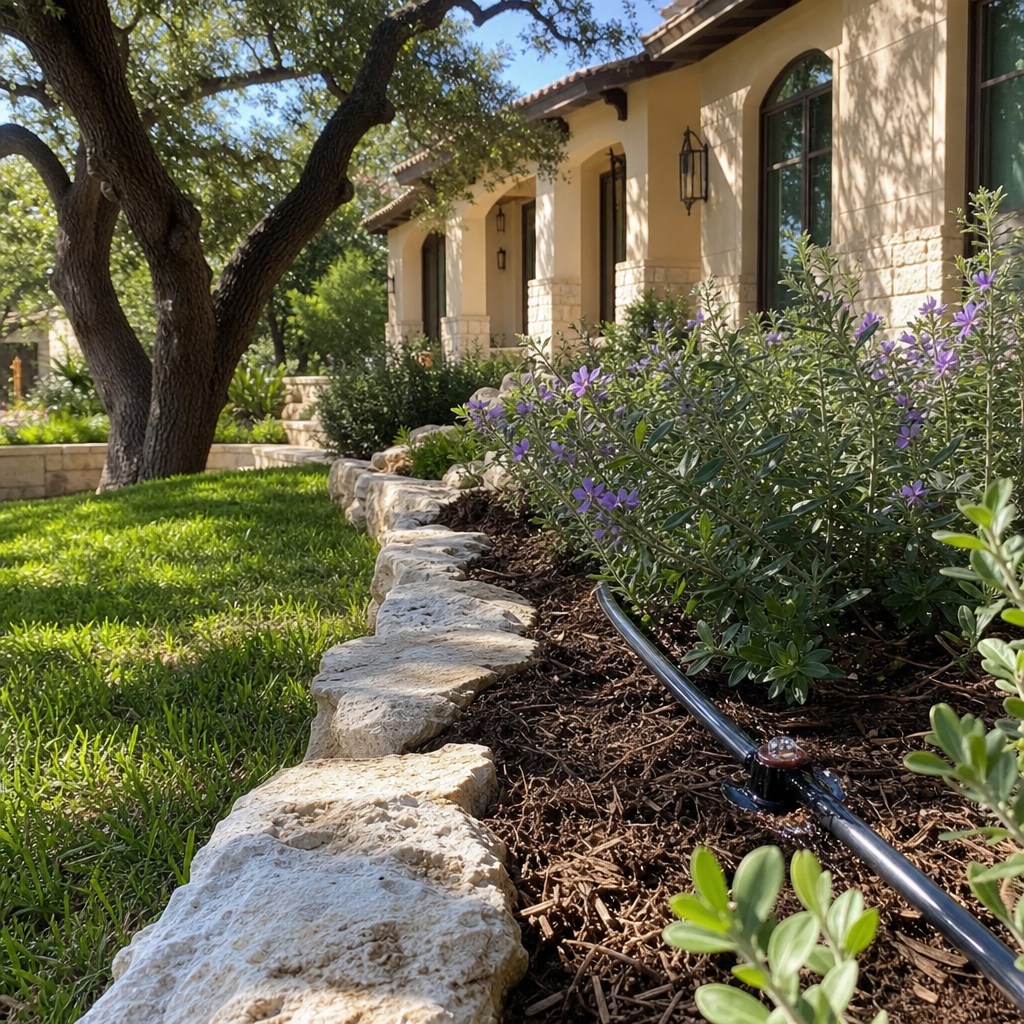
Drip suits beds, trees and shrubs, because Stage 3 lets drip and tree bubbler zones run on Monday and Friday while sprinkler zones are limited to your single weekly day. Spray or rotor zones suit turf. Most San Antonio yards end up with both, on separate zones.
The hours matter as much as the method. Stage 3 allows irrigation systems only 5 to 10 a.m. and 9 p.m. to midnight on your day. That means a turf area has to be watered deeply in one window, which pushes you toward correct nozzle matching and a controller you can program by day.
Two more rules to design around, both from the SAWS Stage 3 page: residential vegetable gardens may be watered by drip three days a week (Monday, Wednesday, Friday) during Stage 3 hours only, and hand-held hoses are allowed any time on any day. Your irrigator should build zones so you can follow these without rewiring.
What can a smart controller and rain sensor do for me?
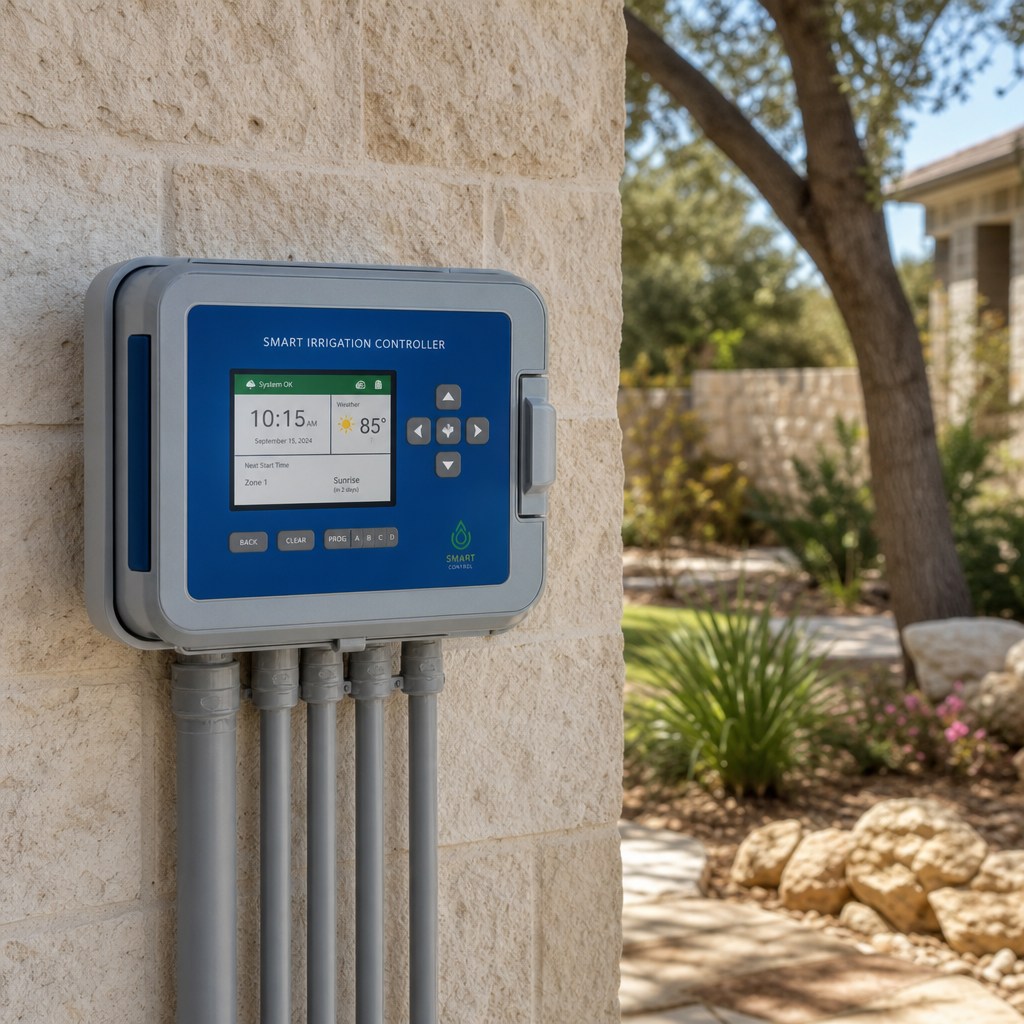
A smart controller adjusts watering to weather and lets you change schedules when the stage changes. SAWS lists rain sensors, smart controller discounts and commercial irrigation design rebates among its conservation programs, and the city requires a rain shut-off device on new systems, so these are worth specifying in the quote.
Check three things with the irrigator: whether the controller can hold separate programs for sprinkler and drip zones, whether it can be set to your address day, and whether you get the login and the manual at handover. A controller you can’t operate is a controller that waters on the wrong day and earns a water waste charge.
What does an irrigation job typically look like on different San Antonio properties?
The scope shifts with the lot, so here are three typical shapes: a new build, an older retrofit and a larger Hill Country edge lot. They describe the planning and paperwork, not a price, and they are illustrations rather than completed jobs.
A typical new-build lot in the Stone Oak area
A new-construction lot with front turf and side beds is a plan-review job from day one. The builder or owner chooses an irrigator, the irrigator seals a plan, SAWS reviews it, the permit is pulled, the system goes in and the SAWS inspection follows. The owner’s decisions are turf area, bed drip and controller. Time on site is typically days, not weeks, once the plan is approved. See our Stone Oak landscaping page for the neighbourhood side.
A typical older-neighbourhood retrofit near Alamo Heights
Older lots usually already have a system of unknown age. The first decision is whether it is a repair or an addition, because the city permit applies to installations and additions. Mature trees and tree roots shape the trench routes, and an irrigator may propose converting beds to drip. Ask for a record of what is buried. Our Alamo Heights landscaping page covers the local conditions.
A typical Hill Country edge lot near Boerne or Helotes
Larger lots with rock close to the surface often use a mix: turf only near the house, drip for native plantings farther out. The irrigator’s main job is the zone map and the backflow assembly location. If the property is outside the SAWS service area, the water provider and its rules differ, so confirm who serves the address before you plan. Local pages: Boerne and Helotes.
When should I plan the sprinkler work around other yard projects?
Do irrigation before sod, beds or hardscape that would have to be torn up for trenching. The irrigator needs the layout of patios, walls and planting beds to route lines and place heads, so plan the whole yard on paper first and let the irrigation design follow it.
That sequence also protects your sod. If you lay turf and then trench through it, you pay twice. Our landscape design page explains how we map a yard, and our hardscaping planning page covers the permit side of patios and walls. For the lawn once it is established, see lawn mowing.
What are the common mistakes homeowners make with irrigation in San Antonio?
The common ones are hiring without checking the licence, assuming the contractor handles the SAWS plan, ignoring soil depth, and leaving the controller on a summer schedule through a stricter stage. Each one is fixable at the quote stage and expensive afterwards.
The list we see most often:
- Signing a quote with no licence number on it.
- Assuming SAWS plan review replaces the city permit. SAWS says it does not.
- Skipping the soil depth check and failing the inspection on the sod bed.
- Forgetting that backflow testing repeats every year after the first install.
- Running zones on the wrong day after moving house or after a stage change.
Can I do my own irrigation work?
The rules we found are written around licensed individuals supervising installation, so for a new underground system the safe answer is to hire a licensed irrigator. For small fixes, call SAWS Conservation at (210) 704-7283 or the TCEQ before you assume what is allowed, because the rules are specific and the penalties are real.
A useful habit is to ask the same question of every professional: what does the rule say, and where is it written? A good irrigator can point to the TCEQ rule, the city permit bulletin or the SAWS page. If an answer is vague, get a second quote.
Who do I call for what?
Keep this short list handy so you know the right desk for each question.
- Is this person licensed? The TCEQ licensing search, linked from the TCEQ Landscape Irrigation page.
- Is my plan approved, and when is my inspection? SAWS Conservation, (210) 704-7283.
- Do I need a city permit and what does it cost? City of San Antonio Development Services.
- Which stage are we in? The SAWS homepage banner and drought restrictions page.
- What belongs in the yard around the system? Us, through the free quote form or (210) 864-8662.
We serve suburbs across the metro, listed on our areas we serve page.
What should I do first?
Start by deciding what the yard should look like, then collect two written quotes from irrigators whose licence numbers you have verified on the TCEQ search. Share the sealed plan with us if you want a second set of eyes on the planting side, and keep the permit and the SAWS approval together in one folder.
When you are ready to talk through the landscape side, call (210) 864-8662 or send the free quote form.
Who can handle irrigation system installation in San Antonio?
A TCEQ licensed irrigator. Texas licenses landscape irrigators through the TCEQ, and city code and the SAWS regulations say a licensed individual must be present and supervise a new system. We are a landscaping company, not your irrigator, so we help you plan the yard and compare quotes from licensed professionals instead.
Our hiring checklist also works for vetting irrigators.
What does yard irrigation installation in San Antonio involve from start to finish?
It runs through six stages: scope the yard, collect written quotes from licensed irrigators, get a sealed plan reviewed by SAWS, pull the city permit, build and test, then pass inspection. SAWS says stamped plans are approved or returned within five business days, and most of the waiting is paperwork.
How often can a new San Antonio irrigation system run under Stage 3?
Once a week on your designated day, from 5 to 10 a.m. and 9 p.m. to midnight. Your day comes from the last digit of your street address. Drip and tree bubbler zones may run Monday and Friday in the same hours. SAWS showed Stage 3 in effect when we checked on October 13, 2026.
The watering restrictions page and the Stage 3 summary keep the schedule in plain English.
Where does irrigation fit in a San Antonio landscape plan?
After the planting plan. The irrigation design follows what goes where: turf, beds, trees, a garden. Thin soil over caliche and limestone decides where lines can run and how deep beds get, so settle the layout and drainage first, then hand licensed irrigators one clear scope to quote.
Start with landscape design and the soil guide, then use the free quote page for the yard around the system.
What service details belongs with a property request for Irrigation?
Frame the San Antonio irrigation proposal around the specific property, its requested outcome, available documentation, and practical restrictions. Have the respondent list investigation, selected tasks, omissions, cost basis, and consent sequence.
“Our San Antonio crew runs Irrigation across Bexar County every week. Same teams, same schedule, same standard.”— San Antonio Pro Landscape Operations Team
- Professionally managed local crews on dedicated weekly routes
- Serving multiple Bexar County suburbs on fixed route schedules
- Operator-grade scheduling and reporting
- Free written estimates on every job