
San Antonio Pro Landscape handles leaf removal across San Antonio and Bexar County, clearing leaves, pecan hulls and yard debris for homes and businesses. Visits start at $75 for a standard lot and run $100 to $200 under heavy pecan or live oak canopy, haul-off included. Call or request a free estimate today.
Call (210) 864-8662 or get a free quote.
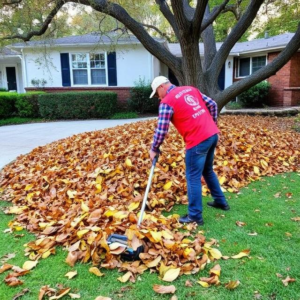
When do leaves fall in San Antonio?
Twice. Pecans drop leaves and hulls in October and November, and Texas red oaks and cedar elms follow in November and December. Live oaks wait until late winter, shedding old leaves from about late February through March as new growth pushes out. Most Bexar County yards need a fall cleanup and a spring one.
Pecans: October and November
Pecans are among the most common shade trees in Bexar County and the messiest in fall. The leaves come down along with the hulls, which are dense and heavy and won’t move with a blower the way leaves do. A mature pecan over a driveway or patio means raking and collecting on top of blowing.
Texas red oaks and cedar elms: November and December
Red oaks hold their color late and then drop in a hurry. Cedar elm leaves are small and stiff, and they work their way into beds, rock mulch and fence lines where they’re slow to pick out. One visit after both have finished usually handles the pair.
Live oaks: late February through March
This is the one that surprises people who moved here from up north. Live oaks keep their leaves all winter, then shed the old ones as new buds swell. Texas A&M’s plant disease lab fields calls about it every year from homeowners who think the tree is dying. For the yard, it means a second round of cleanup right when the lawn is waking up.
Mountain cedar: December through February
Mountain cedar doesn’t drop leaves, but it sheds pollen and fine debris through the winter that coats patios, walks and outdoor furniture. We clear it as part of a winter visit.
A San Antonio leaf calendar, month by month
Put together, the year looks like this. Treat it as a planning guide, since a warm fall or a late cold snap shifts every tree by a week or two.
- October. Pecans start dropping leaves and hulls. The city’s fiscal year resets on October 1, so both free bagged leaf collections are available again.
- November. Peak pecan drop. Red oaks and cedar elms begin. The first cleanup of the season usually lands here.
- December. Red oaks and cedar elms finish. A second visit clears what came down after the first.
- January. Quiet for leaves. Mountain cedar pollen and debris coat hard surfaces. It’s the last full month to trim oaks before the oak wilt window.
- February. Oak pruning stops. Live oaks begin to yellow and shed late in the month.
- March. Peak live oak drop. The spring cleanup goes in once the trees have finished.
- April through June. Stragglers and spring growth. Oaks still shouldn’t be cut.
- July through September. No leaf work to speak of. Oak trimming is back on the table.
How much does leaf removal cost in San Antonio?
Leaf removal in San Antonio starts at $75 for a standard home lot under 5,000 square feet. Yards with heavy pecan or live oak canopy run $100 to $200 per visit, depending on lot size and debris load. A full spring or fall yard cleanup typically runs $200 to $500. Estimates are free.
| Service | San Antonio price |
|---|---|
| Single leaf visit, lot under 5,000 sq ft | From $75 |
| Leaf visit under heavy pecan or live oak canopy | $100 to $200 per visit |
| Full spring or fall yard cleanup | $200 to $500 |
| Commercial property | Quoted after a walk-through |
You can request an estimate online, and it’s based on your lot and tree cover. Recurring seasonal schedules get priority booking and steady pricing. For how leaf work fits with everything else a yard costs here, see our San Antonio landscaping cost guide.
What moves the price of a leaf visit
- Lot size. The $75 starting point is for lots under 5,000 square feet.
- Canopy. Two mature pecans or a row of live oaks put down far more than a couple of young trees.
- Hulls and acorns. Heavy debris has to be raked, swept or vacuumed, which takes longer than blowing.
- Beds and rock mulch. Leaves in gravel, river rock and dense shrubs come out slowly and partly by hand.
- Wet, matted leaves. A pile that sat through two rains weighs more and moves slower than a dry one.
- Access. Narrow gates, steps and steep backyards mean more carrying.
- Haul or mulch. Hauling is the default. Shredding leaves into your beds changes the work, not always the price.
What does our leaf removal service include?
We clear the whole property, beyond just the grass. That covers lawn areas, landscape beds, walkways, driveways, patios and fence lines, using commercial backpack blowers and lawn vacuums. Pecan hulls get collected by hand or vacuum because they don’t blow well. Then we haul everything away or shred it into your beds.
- All turf areas, front and back
- Landscape beds, including under shrubs
- Walkways, driveways and patios
- Fence lines and corners where leaves drift
- Pecan hulls, acorns, cedar debris and general yard waste
- Haul-off, or fine mulching into beds if you’d like to keep the organic matter
Leaf cleanup pairs naturally with regular lawn mowing. A crew that’s already on the property every week or two can keep a light leaf layer from ever becoming a thick one.
How a leaf cleanup visit works, step by step
Six steps, and for most homes the whole thing is one visit. The slow parts are the beds and the heavy debris, so that’s where the time goes.
- Estimate. Tell us the lot size and what trees you have, or we come by and look. We’re checking canopy, beds, access and whether there are hulls. There’s no charge, and it’s a short visit.
- Timing. We schedule around your trees. In fall that means after the pecans have mostly finished. In spring it means after the live oaks have dropped. Go too early and you pay to do it twice.
- Blow out the edges. Crews start with beds, fence lines, corners and the spaces around AC units, moving everything out to open lawn. Yards with rock mulch or thick shrubs take longest here.
- Collect. Vacuums and tarps pick up the piles, and hulls and acorns get raked or vacuumed. A standard lot is usually an hour or two of work. Heavy canopy on a big lot can take most of a day.
- Hard surfaces. Walks, drives, patios and the curb line get blown clean, back into the yard and never into the street. City code doesn’t allow clippings in the street where they can wash into a storm drain.
- Haul or mulch. Everything goes on the trailer and leaves with us, or gets shredded into your beds. Nothing is left bagged at the curb unless you ask for that.
Will the City of San Antonio pick up my leaves?
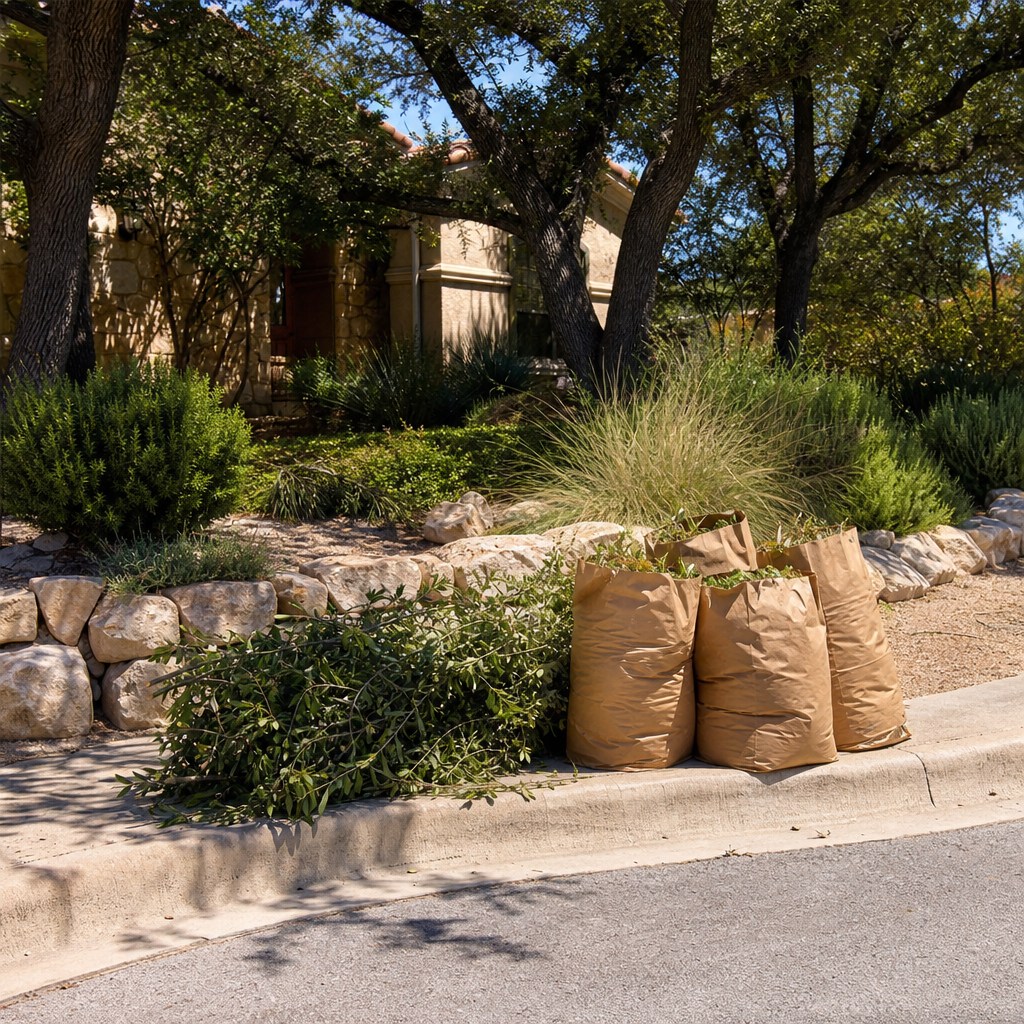
Yes, if you bag them right. City solid waste customers can put loose or paper-bagged leaves in the green organics cart, which is collected weekly. You can also request two free bagged leaf collections each fiscal year, October 1 through September 30, by calling 311. Plastic bags and bags labeled compostable aren’t accepted.
The green organics cart
The green cart is collected every week on the same day as the blue recycling cart. Leaves, grass and yard clippings can go in loose or in kraft bags, leaf bags or plain brown paper bags. Branches have to be cut into 3 foot sections, up to 4 inches thick. Rocks and soil don’t belong in it.
Free bagged leaf collection
- Two free curbside collections per fiscal year, requested online or through 311
- Kraft paper bags only, two-ply, securely closed, no boxes and no plastic
- No more than 40 pounds per bag
- Up to 50 bags or 8 cubic yards per collection
- Extra collections in the same fiscal year cost $20
Brush collection is a different program
The city collects curbside brush twice a year and tells you your week with a door hanger 7 to 10 days ahead. Piles can be up to 8 cubic yards and have to sit within 8 feet of the curb. Bagged leaves aren’t accepted in a brush pile, so leaves and limbs go out separately.
What you can’t do with leaves in the city
Two rules catch people. First, City Ordinance Section 34-703 makes it illegal to put grass or leaf clippings into the street where they wash into the storm drains, which run to the creeks and the river. Second, the fire code makes it unlawful to burn leaves, brush or tree limbs inside the city limits without a permit. Bag them, cart them, mulch them or have them hauled.
The city programs work fine for a small yard with a tree or two. Under mature pecans or live oaks the bag count climbs fast, and that’s where a crew with vacuums and a trailer saves you a couple of weekends.
Is it better to mulch leaves or haul them off in San Antonio?
Both work, and the soil here makes mulching worth a look. Much of Bexar County sits on heavy Blackland clay, and the north side is thin soil over limestone and caliche. Both improve with organic matter, so shredded leaves in beds help. Thick, whole-leaf mats on turf should always come off.
Mulch-mowing a light layer
Texas A&M AgriLife’s leaf management plan says a light covering of leaves can simply be mowed and left in place as shredded bits, and that it works best with a mulching mower. The same guide points out that leaves hold 50 to 80 percent of the nutrients a tree pulls from the soil and air in a season. Hauling all of it away every year sends that to the landfill.
Shredded leaves in beds
AgriLife’s numbers are a 2 to 3 inch layer of shredded leaves in annual and perennial beds, and 3 to 6 inches around the base of trees and shrubs. For new beds on our clay, a 6 to 8 inch layer of leaves tilled into heavy soil improves aeration and drainage. Shredded is the key word. Whole live oak leaves are leathery and sit for months.
When hauling is the right call
Haul when there’s simply too much, when the debris is hulls and acorns instead of leaves, when beds are already full, or when leaves have matted on the lawn. Rock beds are another case. Leaves left in gravel or river rock break down into a layer of soil, and weeds move in.
What happens if you leave leaves on a San Antonio lawn?
A thick layer smothers turf and holds moisture against it. St. Augustine and zoysia, the common lawns here, are prone to large patch, a fungal disease that takes advantage of cool temperatures and wet soil in fall and spring. Leaves also clog drainage paths, so water backs up toward beds and the house.
Clay, caliche and standing water
Most of Bexar County is thick clay that swells when it’s wet and drains slowly. On the north side, thin soil over limestone and caliche has even less room to soak water in. San Antonio averages only about 32 inches of rain a year, but it often arrives in a hard storm. Leaves piled in a swale, against a fence bottom or over a drain grate act like a dam when that happens.
Why winter leaves matter in a mild climate
Lawns here don’t spend winter under snow. Fall and early spring are cool and can be damp, which is exactly when large patch shows up as circular, discolored patches. AgriLife notes it thrives in lawns with poor drainage. A wet leaf mat makes drainage at the surface worse. You can check a suspect patch yourself: a diseased shoot pulls out easily and has a dark, rotten-looking spot at the base.
Why do live oaks drop leaves in spring, and is my tree dying?
It’s almost always normal. Live oaks shed their old leaves as new ones emerge, and Texas A&M’s plant disease lab describes it as normal and not a disease problem. Check a twig: if new buds are swelling at the base of the yellowing leaves, the tree is fine. If branches are brittle and brown inside, call an arborist.
The timing varies from tree to tree and year to year. Two live oaks in the same yard can drop a couple of weeks apart, which is why we don’t book spring cleanups by date alone. We’d rather come once after the last tree finishes than twice.
Can you trim oak trees during a spring leaf cleanup?
Not between February and June. Texas A&M Forest Service asks Texans to avoid pruning or wounding oaks in those months, when the sap beetles that spread oak wilt are most active. That window overlaps the live oak leaf drop. So spring cleanup means leaves only, and any oak cut at any time gets painted right away.
Oak wilt moves two ways, above ground on those beetles and below ground through connected roots, so one infected tree can put a whole street’s live oaks at risk. Trimming is best planned for July through January. If a storm breaks an oak limb in spring, the fresh wound should be painted the same day.
How do you clean up pecan hulls and heavy debris?
Pecan hulls are dense, so blowers alone won’t move them. We rake and vacuum hulls off turf, sweep them from driveways and patios, and pull them out of beds by hand where they’ve piled up. Hulls, acorns and seed pods all go on the trailer with the leaves, since they break down slowly in beds.
Hulls that sit wet can leave dark marks on concrete, so hard surfaces under a pecan are worth clearing early in the season instead of waiting for the last leaf.
Example scopes and price math
These are typical scopes priced from our published ranges, not specific jobs. They show how the numbers add up for common San Antonio yards.
Example scope: one fall visit on a small lot with light canopy
A lot under 5,000 square feet with a couple of young trees. Scope: blow out beds and fence lines, collect from the lawn, clear the drive and walk, haul off. This is the $75 starting price. The local complication is usually cedar elm leaves in rock beds, which take hand work.
Example scope: fall visit under two mature pecans
Same size lot, but two big pecans over the backyard and driveway. Scope adds raking and vacuuming hulls and sweeping the drive. That puts it in the $100 to $200 per visit range. For comparison, the city’s free collection tops out at 50 bags at 40 pounds each, and hulls fill bags fast.
Example scope: three-visit season under live oaks and pecans
A yard with both kinds of tree needs a visit in late October or early November, one in late November or December, and one in late February or March. Three visits at $100 to $200 each comes to $300 to $600 for the season. The spring visit is timed to the live oak drop, and no oak trimming gets added to it.
Example scope: full spring cleanup
When the job is more than leaves, with beds cleaned out and the whole yard reset for the growing season, it’s priced as a full seasonal cleanup at $200 to $500.
Should you book one visit or a seasonal schedule?
If you’ve got pecans, live oaks or cedar elms overhead, a schedule of two or three visits between October and March usually beats one big cleanup. Leaves come off before they mat, each visit is lighter, and you’re not waiting for an open slot in the busiest weeks. Recurring customers get scheduled first.
One-time visits are fine too, and we fit them into open slots. They make the most sense for a yard with one kind of tree that drops all at once, or for getting a property ready to sell or host.
Do you handle leaf cleanup for commercial properties?
Yes. We do seasonal cleanup for office complexes, retail centers and other business sites across San Antonio, priced by property size and debris volume after a free walk-through. Parking lots and entries get cleared first, since wet leaves on pavement are a slip risk and leaves in the curb line end up in the storm drain.
Leaf work is usually one line in a larger grounds contract. Our commercial landscaping page covers how those are scoped and priced.
Where do we offer leaf removal around San Antonio?
We run leaf cleanup across San Antonio and Bexar County, including Stone Oak, Alamo Heights, Helotes and Leon Valley, plus Schertz, Cibolo, Selma, Live Oak, Converse and Universal City on the northeast side. We also cover Boerne, Bulverde and New Braunfels. Older neighborhoods with mature pecans and live oaks keep us busiest.
Local pages: Stone Oak, Alamo Heights, Helotes, Schertz, Cibolo, Selma, Live Oak, Converse, Universal City, Boerne, Bulverde and New Braunfels. The city collection rules above apply to City of San Antonio solid waste customers. The suburbs run their own programs.
Leaves piling up? Call (210) 864-8662 or get your free leaf removal quote. Tell us what trees you’ve got and we’ll tell you when to book.