
Last updated: October 6, 2026
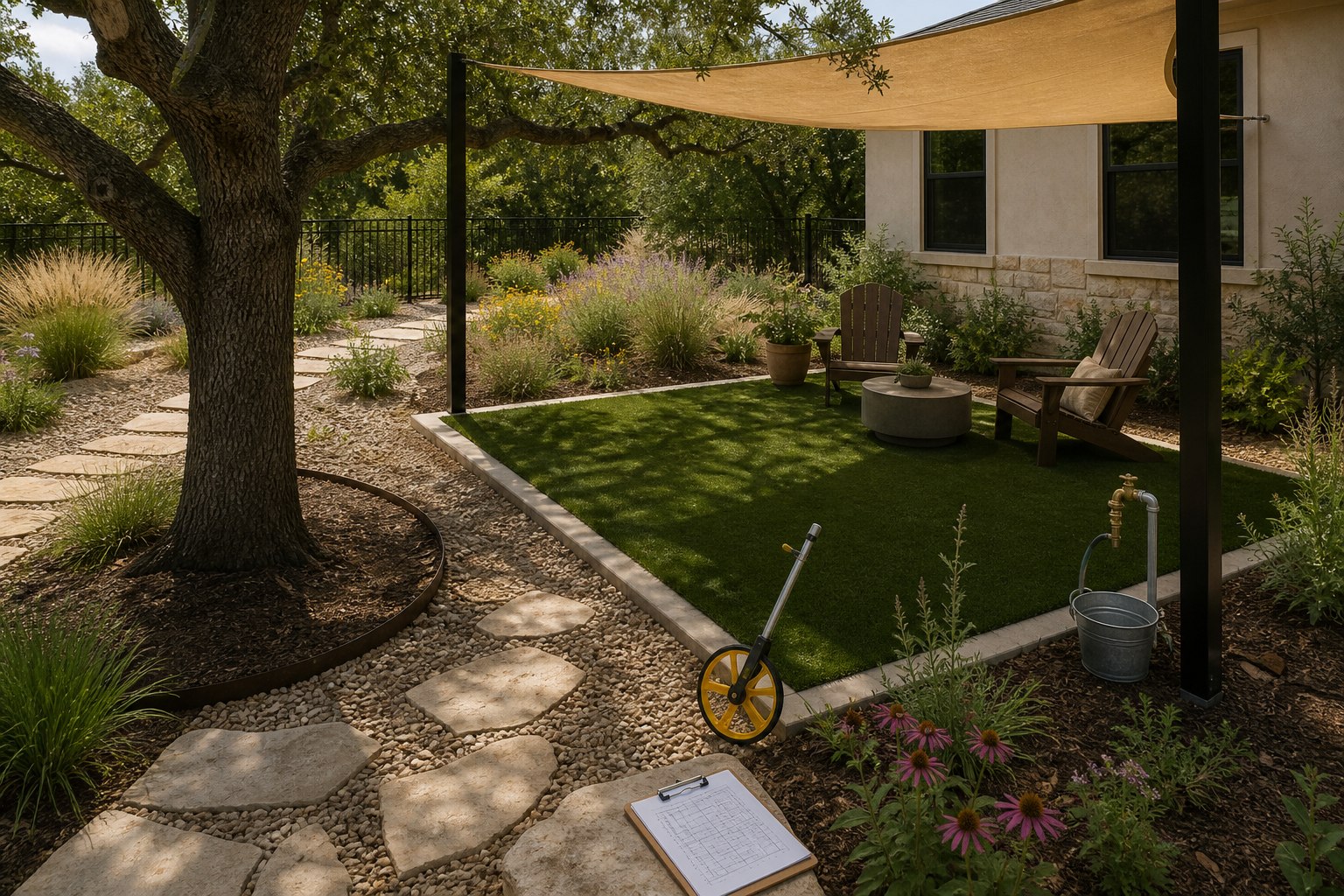
Artificial turf is often sold by subtracting chores: no mowing, no fertilizing, no brown grass, no sprinkler schedule. That list does not reveal whether the installed surface will be comfortable at 4 p.m., compatible with a live oak, easy to rinse without street runoff, or worth removing when the product reaches the end of its useful life.
For a San Antonio property, the better question is not whether synthetic turf is good or bad. It is which measured square feet perform a real, repeated job better than living grass, native planting, mulch, or a paved surface. That change in question usually produces a smaller, more useful project.
Give every synthetic square foot a job
Measure the yard and divide it by actual behavior. Where do children play? Where does a dog turn repeatedly? Where are chairs moved for gatherings? Which strip is only viewed from a window? Which area already grows acceptably under the current watering schedule? A surface with no named use is being purchased mainly for visual continuity, and visual continuity can become the most expensive part of the scope.
Create a simple use ledger for two ordinary weeks. Record the activity, number of users, time of day, duration, wet or dry condition, and whether the same activity could occur on a smaller pad. A compact rectangle with clean access is easier to brush, rinse, repair, and eventually replace than a shape cut around every trunk, bed, utility, and fence corner.
Keep non-use space in contention. A shaded sitting edge may be better as decomposed-granite fines or limestone paving selected for the load and accessibility need. A sunny decorative strip may deliver more value as drought-resilient planting. A functioning lawn zone may remain living turf. The existing xeriscape-versus-lawn comparison addresses those living-landscape choices; synthetic turf is a separate surface decision.
How do I tell whether artificial turf will be too hot for my San Antonio yard?
Test the exact product on site, not a color chip. Set a meaningful sample of the proposed turf and infill in the yard and compare it with your existing surfaces under the same sun and shade in late morning, early afternoon and late afternoon. UT San Antonio’s extreme-heat work treats vegetation and shade as heat-mitigation tools.
A canopy circle on a plan does not show when shade arrives. Photograph the proposed bay from the same position in late morning, early afternoon, and late afternoon during the season when it will be used most. Note shadows from the house, fence, live oak, and any removable shade structure. The uncomfortable hour can be more important than the daily average.
UT San Antonio’s current extreme-heat work describes vegetation and shade as heat-mitigation tools and notes that paved surfaces absorb heat. Synthetic turf products differ, but none should receive a comfort assumption from a color chip or brochure. Obtain the exact proposed product and infill, place a meaningful sample at the site, and compare it with the existing surfaces under the same sun and shade.
Use a surface thermometer consistently if one is available, but let touch and behavior remain part of the decision. Record air conditions, cloud cover, surface reading, shade state, and whether a barefoot person or pet could use the material comfortably. Watering a hot sample can create a brief result while adding a recurring water task; it is not evidence that the untreated surface fits the use.
Does artificial turf qualify for the SAWS WaterSaver Landscape Coupon?
Not under the published terms, which describe a plant purchase and don’t list synthetic turf as eligible. The fall 2026 coupon offers residential customers $150 per coupon, up to $600, for replacing water-demanding grass with new plants. Each coupon requires removing at least 200 square feet of grass plus the sprinkler heads or drip lines there.
SAWS’s July 2026 fall-coupon announcement offers residential customers $150 per coupon, up to $600, for replacing water-demanding grass with new plants. It says each coupon requires removal of at least 200 square feet of grass and the automatic sprinkler heads or drip lines in that project area. Coupons begin distribution August 15 and are redeemed through participating nurseries under the program’s deadlines.
Those published terms describe a plant purchase, not a general reimbursement for any grass replacement. They do not list synthetic turf as an eligible item. A household considering both should draw two zones and two budgets: the plant-coupon area that follows current SAWS requirements, and any synthetic-use bay purchased under its own economics. Confirm eligibility and deadlines directly with SAWS before removing grass or irrigation.
That separation also prevents a false water comparison. Synthetic turf eliminates routine irrigation for living grass inside its footprint, but it may still use water for rinsing or temporary cooling. Native and adapted plants need establishment water and ongoing care, but they retain biological and shade functions that a plastic surface does not. State the water tasks for each zone rather than labeling one simply water-free.
Can I install artificial turf under a live oak in San Antonio?
Only with the roots protected. Mark the trunk, canopy, visible surface roots, base depth, equipment route and every cut on one drawing before anyone digs. Where roots make excavation or compaction inappropriate, change the shape or move the turf bay. The City’s tree ordinance may also apply, depending on the scope and property status, so check the current process.
San Antonio yards often depend on mature live oaks for their most valuable afternoon shade. Do not let a neat turf outline authorize excavation through important roots, grade changes at the trunk, or an impermeable-looking edge detail without review. Mark the trunk, canopy, visible surface roots, proposed base depth, equipment route, and all cuts on one drawing.
The City of San Antonio’s tree ordinance applies specific preservation requirements to covered development, and the City’s process depends on scope and property status. A routine residential surface project is not automatically equivalent to a regulated development, but that distinction should come from the current City process—not from an installer’s assumption. Historic overlays, recorded easements, utilities, and homeowners-association rules are separate checks.
Where roots make excavation or compaction inappropriate, change the shape or move the bay. Retaining the tree while destroying the soil conditions that sustain it is not preservation. The long-term shade benefit is also part of the turf comfort plan.
Can I hose off artificial turf under SAWS water rules?
You can rinse it, but the water has to stay on your property. SAWS classifies runoff into a gutter, ditch or storm drain as water waste, and that applies even when you’re cleaning and not growing grass. Keep rinse volumes controlled. Water that reaches the street drainage system travels to local creeks and rivers, not a treatment plant.
List what will land on the surface: dust, pollen, oak litter, food, pet urine, windblown mulch, irrigation overspray, and muddy shoes. Then assign a removal method and frequency. A blower may move dry leaves; it does not sanitize a pet area. Water may rinse a surface; it also carries dissolved and suspended material somewhere.
SAWS classifies runoff into a gutter, ditch, or storm drain as water waste and prohibits irrigation overspray and runoff. That rule matters even when the water is being used to clean rather than grow grass. Keep rinse volumes controlled, use products appropriate for the receiving area, and show where the water will remain on the property without ponding against the building or moving waste into the street.
Inspect the proposed bay after a real storm. The San Antonio River Authority explains that water entering the street drainage system travels to local creeks and rivers rather than a sanitary treatment plant. If the surface collects litter, loose infill, or pet waste and releases it at an edge, the project needs containment and maintenance changes before expansion.
Make irrigation abandonment reversible and legible
Do not leave unidentified active heads beneath the new work. Document the existing controller zone, valves, heads, drip lines, sleeves, and the plant material each component serves. Cap, remove, or reconfigure the system according to the approved plan, then update the controller legend.
A whole zone may also feed a tree or bed beyond the proposed turf. Abandoning it indiscriminately can damage the living landscape that provides shade. Conversely, continuing spray irrigation across synthetic turf to reach another zone wastes water and complicates cleaning. Separate hydrozones and provide accessible isolation points.
SAWS drought stages can change. The current rules page, not an article captured months earlier, should control the installation-day schedule for any retained or newly planted living areas. SAWS also offers irrigation consultations and publishes separate variance rules for qualifying new landscapes. Synthetic turf itself does not create permission to ignore runoff or water-waste restrictions.
Price the invisible work as named line items
A useful proposal identifies the product and the site preparation, not only a pile height and installed square-foot number. Require the measured area, excavation depth by zone, disposal quantity, base materials and compacted depth, grade-control method, seam layout, fastening, edge transition, infill product and quantity, root exclusions, utility protection, access restoration, and cleanup.
Ask what happens at doors, drains, fence lines, beds, and irregular limestone. These interfaces often determine whether the installation remains flat, clean, and repairable. Specify how a damaged section is opened and patched, whether matching material will be available, and how concealed utilities can be accessed.
A warranty should be read for exclusions involving reflected heat from windows, pet use, weeds, drainage, settling, discoloration, melting, workmanship, and maintenance. Product warranty and installation warranty are different obligations. Preserve the product label, lot or roll reference, infill record, photographs before infill, and final care instructions.
Build the exit cost into the entry decision
Synthetic turf is replaceable material. Request a separate present-day line item for lifting the surface, removing infill and base where necessary, hauling material, restoring grade, and preparing the area for its next use. That is not a forecast of a future price; it exposes what physical work the design creates.
Favor shapes that can be removed without dismantling the rest of the yard. Avoid trapping tree roots, irrigation connections, drains, or access panels beneath an uninterrupted field. Keep a drawing of seams and buried components with the property records.
For an uncertain use, build a small finished pilot bay first and live with it through hot afternoons, a storm, leaf drop, a gathering, and routine cleaning. Record what actually happens. Expand only if the surface earns more square feet. A pilot that reveals too much heat or maintenance is successful evidence, not a failed purchase.
San Antonio Synthetic-Turf Decision Sources
- San Antonio Water System: fall 2026 WaterSaver Landscape Coupon amounts and grass, irrigation, and plant-purchase terms
- San Antonio Water System: year-round water-waste and runoff rules
- San Antonio Water System: current drought stage and watering rules
- UT San Antonio: current local heat research and mitigation context
- City of San Antonio Development Services: tree ordinance and preservation process
- San Antonio River Authority: runoff pathway and local creek water-quality context